
A regional storefront shows suggestions for an earlier search after the user has typed a new query. Both requests may have succeeded through the proxy. The defect can be in which response the application allows to update the page, rather than in the delivery of either response.
This guide proposes controlled acceptance cases for autocomplete on owned or explicitly authorized sites. It tests whether the current query and market retain ownership of visible suggestions when responses finish out of order. It does not report executed results or claim that a proxy inherently causes or fixes application races.
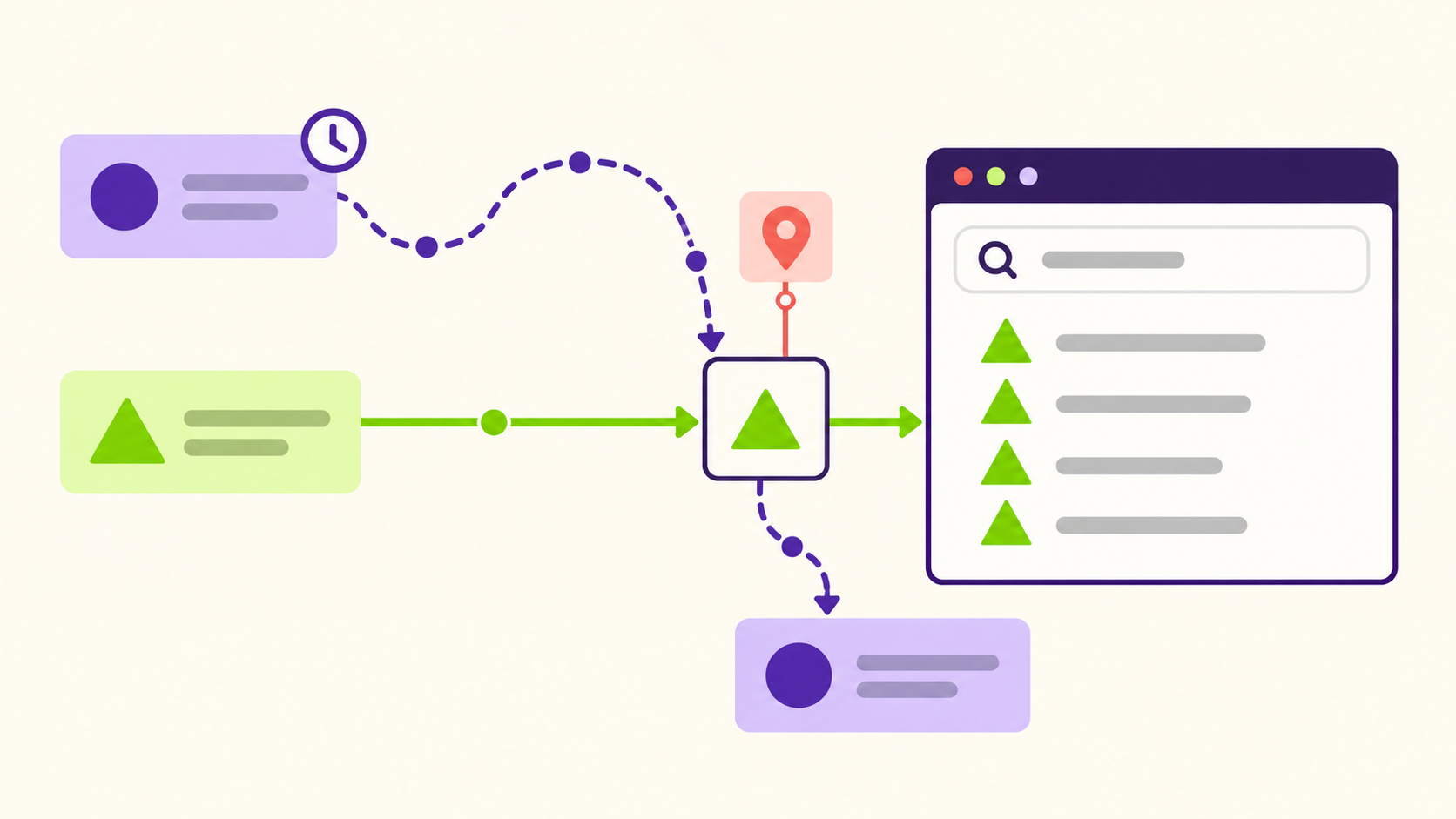
1. Define the active search state
Agree on what identifies a search: query, market, language and any approved filter that changes the result set. Give each new search intent a monotonically increasing generation or equivalent unique ownership token. Reusing the same query text later must not accidentally revive an older in-flight request.
Define the visible-state contract during loading. The application may clear old suggestions, or retain them with an explicit stale/loading label and restricted interaction. Choose one behavior with the product owner; do not treat unlabelled old results as current just because the page has not finished loading.
Separate suggestion success, an empty result and a failed request. A late failure from an obsolete query must not replace the current success with an error. An obsolete success must not clear the current loading state.
2. Prepare two unmistakable response fixtures
- Create harmless query A and query B fixtures in owned staging, each with a distinct visible suggestion marker and stable item IDs.
- Record their expected market and language independently from the response being tested.
- Provide a controlled way to hold and release each response, using an authorized test endpoint or response mock.
- Issue A, then B. Release B first and confirm its suggestions become current.
- Release A afterward. Verify the visible list, selected item, loading flag and error state still belong to B.
Do not depend on random proxy slowness to create a particular completion order. A deterministic release gate demonstrates the semantic failure more clearly. Once that fixture passes, observe the same client on approved network routes without assuming their timing will reproduce the controlled schedule.
3. Check ownership at the final state update
The application should compare a completion's captured ownership token and search context with the active intent immediately before committing UI state. A stale completion can be logged as ignored, but must not overwrite current data, errors or loading indicators.
Apply the check after asynchronous parsing or transformation as well as after transport completion. A response can arrive first yet finish a later parsing step after another search has become current. A check made only when the request starts cannot establish ownership at commit time.
React's official data-fetching guidance illustrates ignoring obsolete results during effect cleanup to avoid race conditions. The general acceptance requirement here is framework independent: prove that obsolete work cannot commit to the current view. This guide does not prescribe a particular hook implementation for every application.
4. Treat cancellation as a separate observation
MDN documents AbortController.abort() for stopping supported asynchronous operations, including fetch and response-body consumption. It can help reduce unnecessary client work. A canceled request is still not the same evidence as a protected state-commit boundary.
Test a completion that has already moved beyond the cancellable transport stage, or a controlled mock that delivers an obsolete result anyway. The current search should remain intact. Do not declare the race fixed solely because an earlier network request displays canceled in developer tools.
Keep cancellation, stale-result rejection and current-request failure in separate evidence columns. Neither a canceled obsolete request nor its ignored error should be presented to the user as failure of the active search.
5. Include market switches and cleared input
Hold a response for market A, switch the visible market to B while keeping the same query, then complete B and release A. Confirm suggestion labels, item IDs and click destinations remain scoped to B. Check the destination before navigation; do not execute a purchase or other business side effect.
Also clear the search box while a request is pending. Clearing should invalidate the earlier intent under the agreed contract, so its late response cannot reopen the suggestion list. Return to the same query afterward and verify that its new generation, not the old request, controls the result.
The 98IP dynamic residential IP page is relevant when planning authorized regional storefront tests. Check current connection methods and account options through the API configuration page. Proxy routing does not implement your application's request ownership or guarantee a response order.
6. Run a bounded fault matrix
- A then B, B finishes first: late A cannot replace B.
- Obsolete A fails after B succeeds: B remains successful without an unrelated error.
- Market changes with identical query text: old-market suggestions cannot become interactive.
- Input is cleared before completion: the late result cannot reopen the old list.
- Same query is entered again: its new ownership token prevents an old generation from committing.
- Transport finishes but parsing is held: a later parsing completion still needs a current ownership check.
These are unexecuted acceptance cases. Set a fixed deadline and release order for each. If the fixture never reaches its intended checkpoint, mark it incomplete, not passed. Debouncing may reduce request frequency, but it does not by itself establish which already-issued response may update the page.
Record case ID, build, browser, route label, synthetic query ID, market, ownership token, response-release order and final visible-state owner. Avoid retaining real user searches or full browsing data. Use sanitized event records to distinguish received, parsed, ignored and committed completions.
FAQ and release checklist
Does HTTP 200 mean a suggestion should be shown? No. The result must still belong to the active search context.
Will switching proxies repair stale suggestions? It may alter timing, but cannot replace an application ownership check.
- Query, market and language context are explicit.
- New intents invalidate obsolete ownership, including clear and repeat actions.
- Data, errors and loading updates all obey the same ownership rule.
- Response ordering is controlled independently from network timing.
- Current suggestion IDs and destinations match the intended market.
- Only authorized staging fixtures and small request budgets are used; no untested conversion, latency or reliability gains are claimed.
Related Recommendations
- Proxy Exit IP Allowlist Rollover: A Zero-Downtime Migration Runbook
- Regional Pages Load Through a Proxy: Check for Unintended noindex Rules
- SOCKS5 vs HTTP Proxies: A Protocol Selection and Acceptance Guide
- How to Test ALPN and HTTP Version Negotiation Through a Proxy
- How to Validate a Proxy SLA Before You Buy
- How to Estimate Proxy Bandwidth Before Choosing a Plan
- HTTP 200 Is Not Enough: Validate Regional Ad Landing Pages Before Launch
- How to Test a Proxy Client Circuit Breaker Without Stopping Healthy Markets
- Residential Proxy Evaluation Checklist: 7 Tests to Run Before You Buy
- How to Capacity-Plan Proxies for 200 Parallel Browser Sessions