
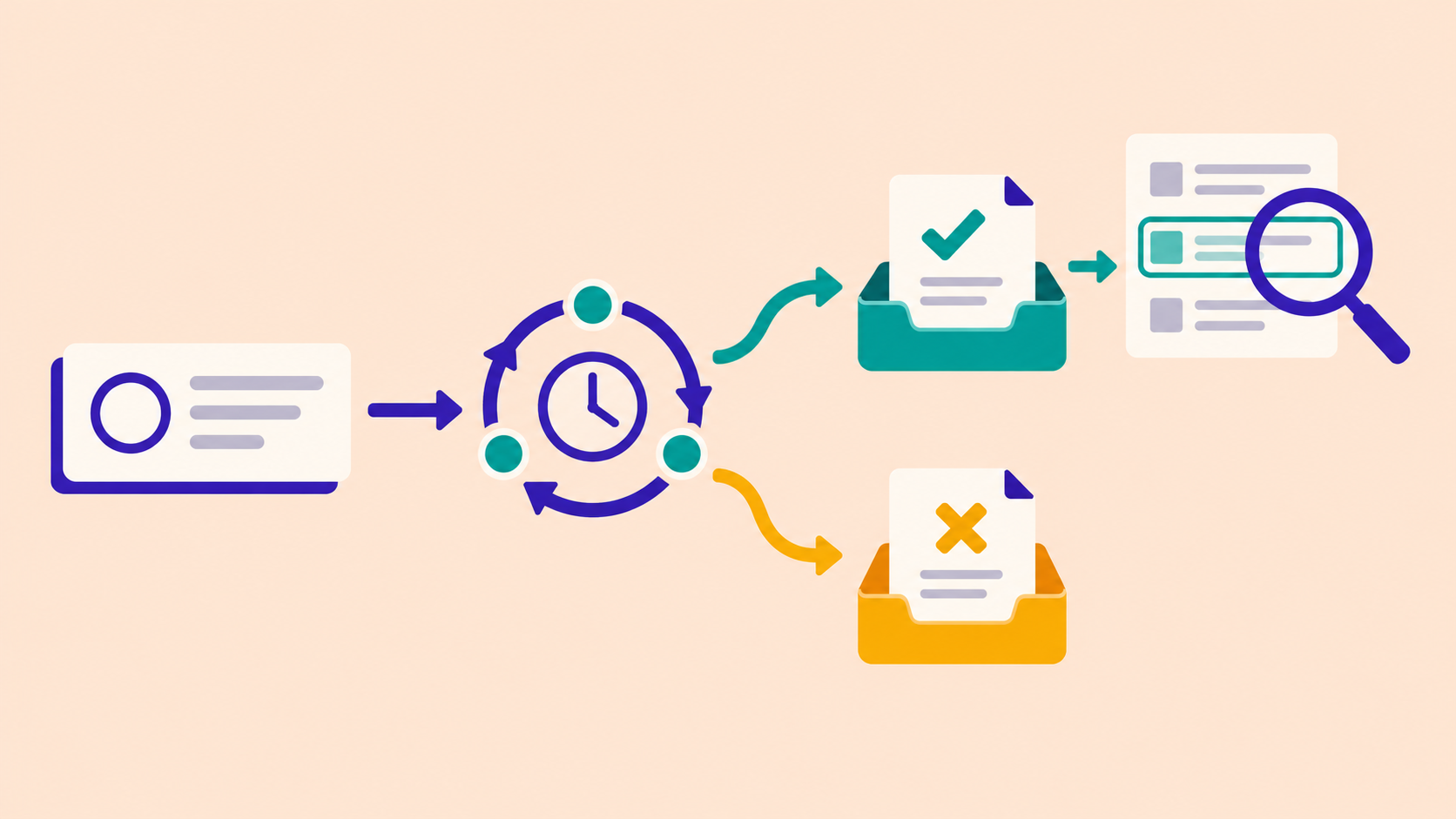
An approved export request returns HTTP 202 through a proxy. The connection worked and the server accepted the request, but the report is not necessarily ready. Treat submission acceptance, status observation, a terminal job outcome and usable result content as four separate checkpoints.
This guide proposes a bounded test for owned or authorized asynchronous APIs. Its example states are illustrative, not 98IP API fields or measured service behavior. Use a harmless synthetic export in staging rather than creating production orders or repeated real exports.
1. Read the destination API contract first
Identify the documented submission method, accepted response, job reference, monitor address, authentication scope, status vocabulary, result retrieval method and retention period. HTTP 202 indicates acceptance for processing, not guaranteed completion. Do not assume every 202 response contains Location, a job ID, or the same JSON schema.
Agree on terminal success, terminal failure and still-running states using that API's actual rules. A successful HTTP response from the status endpoint can carry a business failure. Conversely, a temporary inability to read status does not establish that the underlying job failed.
2. Create one synthetic job and preserve its reference
- Choose a small known input and expected result, with a case ID that contains no personal information.
- Submit once under the approved test budget. Record the response, submission time, application identity and a masked resource reference.
- Persist the returned job reference and documented monitor location in the test ledger before polling. Store any capability-bearing address only in the approved secret store, not shared logs.
- Validate the monitor's scheme, host and path against the approved destination policy. Resolve a documented relative address against its specified base.
A status URL is not permission to send credentials anywhere it redirects. Apply the destination's documented authorization rules, and do not automatically forward a bearer token to a different origin. A missing or invalid monitor reference is a contract problem requiring investigation, not a reason to guess an endpoint.
3. Keep proxy setup separate from job identity
The 98IP dynamic residential IP product page helps identify the route product used for authorized regional API testing. Confirm the current account's actual location and session options. The API configuration documentation concerns documented proxy setup; it does not establish an asynchronous export interface or job schema for a destination service.
Use the same application identity and job reference across observations. Record the route alias separately. Do not assume that changing the exit IP creates a new job, restores authorization, or is compatible with the destination's session rules. If the service requires session continuity, respect it and label any controlled route-change case explicitly.
4. Put a budget around status checks
Before running, choose a total observation deadline, maximum status calls, per-call timeout and a documented or approved polling schedule. Apply any valid server retry guidance according to the API contract. If a requested wait would exceed the remaining observation window, stop observation rather than polling early to fit the budget.
Use one active poller per job in this test. After a transient status-read failure, retry the status read within the approved budget, preserving the same job reference. Do not restart the submission. Authentication failures need an authorized credential/session check; they are not a signal to hammer the status endpoint or rotate around a restriction.
Keep an observation timeout distinct from a terminal job outcome. When the deadline or call limit is reached, mark the client view unresolved with the last confirmed state and next review owner. Stopping polling does not prove the job stopped, and is not a substitute for a documented cancellation action.
5. Validate the terminal state and the result separately
When the documented terminal-success state appears, retrieve the result through the approved destination path and authorization flow. Check its type, fixture identity, expected record keys and completeness. For a tiny known fixture, an expected content hash may also be useful. A login page or incomplete report behind HTTP 200 is not an accepted export.
Preserve four ledger columns: accepted submission, last observed job state, result retrieval outcome, and result-content verdict. If result retrieval fails, keep the known successful job state and investigate the retrieval path. Do not submit a replacement job simply because downloading its output timed out.
For example, a synthetic job can be accepted, later report success, and then expose a result that lacks one expected fixture key. The correct verdict is “job succeeded; result acceptance failed,” not a proxy success or a reason to increment completed exports.
6. Test recovery without duplicating work
On an owned staging API or documented test adapter, rehearse a delayed terminal state, one temporary status-read error, a terminal business failure, and a successful state with incomplete result content. Confirm each produces a different ledger verdict. These are proposed exercises, not executed measurements.
Also restart the test client after recording the accepted reference. Resume observation of that same synthetic job, ensuring a second worker does not create another poller. If the server says the reference is unknown or expired, follow its documented retention and recovery process. Do not infer that no work occurred, and do not recreate the job until an authorized decision addresses the uncertainty.
For a route comparison, use equivalent separate synthetic jobs on the baseline and proxy route, with the same fixture and observation policy. Compare acceptance, job duration observations and result verdicts separately. One slow observation does not isolate a proxy bottleneck from destination queue time or polling cadence.
FAQ and completion checklist
Can I count every HTTP 202 as a completed task? No. Count only the destination's confirmed terminal outcome and the result checks required by your workflow.
Does every API use 202 while running and 200 when finished? No. Use the destination's documented status and payload rules rather than a universal status-code mapping.
- The job schema, monitor destination and authorization scope are documented.
- One accepted reference survives client restarts without resubmission.
- Polling has a deadline, call limit and approved wait policy.
- Read failures and client observation timeout do not become invented job outcomes.
- Terminal success, retrieval and content completeness are separate verdicts.
- Unresolved jobs have an owner and an authorized recovery decision.
Use only approved APIs and synthetic data, cap requests and retained artifacts, and redact tokens, signed monitor links and proxy secrets. Do not claim measured throughput, bandwidth savings, registrations, orders or completion rates from this proposed test plan.
Related Recommendations
- How to Test Request Cancellation Through a Proxy Without Leaving Orphan Traffic
- How to Test a Multi-Region Proxy Routing Policy Before Production
- How to Test Encrypted Client Hello Through a Proxy
- How to Rotate Proxy Credentials Without Breaking Production
- How to Audit Proxy Geolocation Database Freshness Before a Regional Launch
- Diagnose IPv6 Proxy MTU Black Holes Before They Reach Production
- Proxy NAT64 and DNS64 Compatibility Test for IPv6-Only Networks
- SOCKS5 Remote DNS Resolution Test: Verify the Full Proxy Path
- Proxy Geo-Targeting Accuracy Audit: Test Country, Region, City and ASN Claims
- How to Prevent Clock Skew from Corrupting Proxy Latency and Session Metrics