
An authorized upload or API request returns HTTP411 through a residential proxy. The application retries with another exit, but the same streamed body fails again. First establish whether the receiving service requires a defined request content length. Guessing a Content-Length value or adding it beside an existing transfer coding can introduce a second problem. This guide is a controlled diagnostic procedure, not a report of tested 98IP behavior.
1. Identify the real411 and the receiving layer
HTTP411 Length Required means the server refuses the request without a defined Content-Length. It is not the same diagnosis as content being too large or using an unsupported media type. Save the actual HTTP status, final method/path, response content type, redacted diagnostic body and a non-secret correlation ID.
Separate any proxy CONNECT exchange from the target request inside the established TLS tunnel. A JSON error field or SDK label containing411 is not proof of an HTTP411 response. Identify the emitting layer using approved gateway or target logs when available; response branding alone is only a clue. Do not claim the origin received the body when only an intermediary acknowledgement is available.
Record the negotiated HTTP version and any known protocol translation at owned gateways. An ordinary non-intercepting HTTPS proxy cannot rewrite the encrypted inner request. If authorized TLS inspection exists, document that additional boundary rather than treating every gateway as equivalent.
2. Determine how the final request body is produced
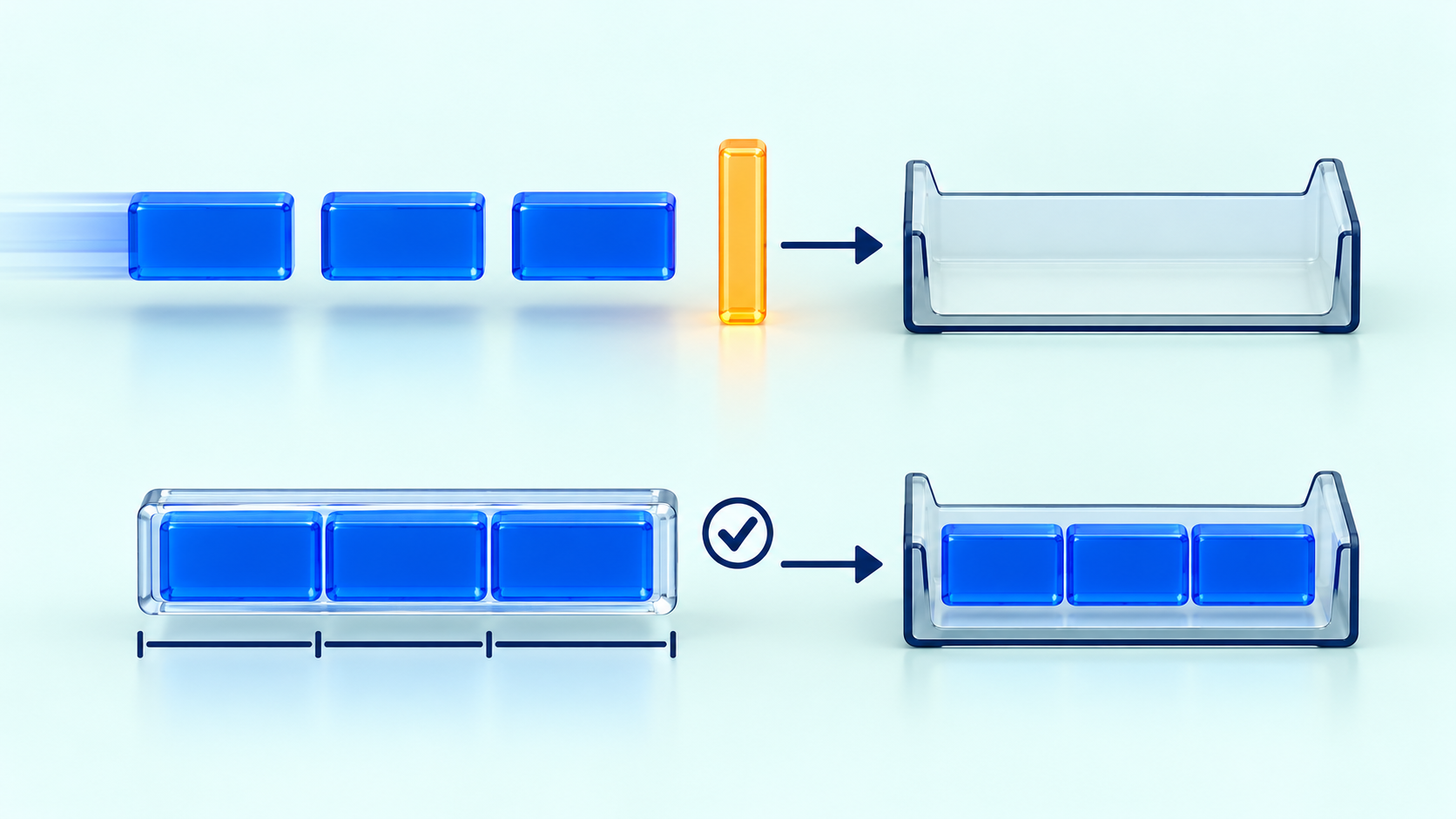
Inspect whether the client sends a finished byte buffer, a file of known size, or a generator/stream whose final size is not known before sending. Observe the final request headers and receiver framing evidence, not just a source-code object. In HTTP/1.1, some services reject a properly chunked request with411 because their gateway requires the total in advance; that does not make all streaming requests invalid.
Content-Length is measured in content bytes, not characters. A Unicode string's character count, an unencoded object's size or the source file size before transformation may be wrong. For a small uncompressed UTF-8 fixture, finalize serialization and encode once, then inspect that byte buffer's length. Keep the same bytes for sending; a later re-serialization can change whitespace, escaping or line endings.
For multipart content, the whole encoded body includes boundaries and part metadata as well as the file. Let a supported client construct and frame it; the attachment's size alone is not the full request length. If request content is compressed, calculate any needed length for the final transmitted content, not the original uncompressed input. Start the diagnostic pair without optional compression to isolate the first mismatch.
3. Compare a prepared body with an unknown-length source
- Use an owned staging receiver with no transaction, email, real customer data or irreversible write. Agree with its owner on whether this endpoint requires a declared length, its size limit and the expected acceptance/rejection. Do not deliberately probe public production framing policies.
- Prepare a small synthetic UTF-8 payload containing a non-ASCII character. Freeze its exact serialized bytes and record an independent byte length and diagnostic digest. These are local fixture expectations, not fabricated measurements.
- Send the prepared bytes through a client mode that supports a known body size and lets the HTTP library construct valid framing. Record final request headers, negotiated protocol, status, receiver-observed content length and decoded fixture acknowledgement.
- If the owned setup supports it, send the same content from the original unknown-length source through the application's normal supported streaming mode. Keep method, media type, endpoint and authorization state fixed. For HTTP/1.1, record whether chunked transfer was actually used; do not assume it from the word stream.
- Compare the expected outcomes with the receiver. If the streaming case is accepted, record that fact; do not manufacture a411. If it is rejected, preserve the evidenced policy and emitting hop.
- Correct the integration using the approved known-length path, then repeat it through an authorized baseline and selected residential route. Verify receiver content matches the frozen fixture, rather than accepting any2xx alone.
If the original stream cannot be replayed safely or the baseline is unavailable, state the limitation. A local stub returning411 can test error handling but does not prove a production gateway's behavior. Do not consume a one-shot stream to count it and then unknowingly send an exhausted stream.
4. Repair framing through the supported client path
For small bounded content, an approved buffer or a securely managed temporary file can provide a known size. Apply explicit memory/disk limits and cleanup, and avoid buffering unbounded uploads. For large or live streams, consult the service owner for a documented streaming, resumable or multipart-upload API. Do not assume that switching to an unrelated endpoint preserves semantics.
Do not send conflicting Content-Length and Transfer-Encoding fields in HTTP/1.1, duplicate length values or a made-up zero length for nonempty content. Let the library own framing. Do not hand-craft malformed requests to find a combination a gateway will tolerate. A successful request must still deliver the expected complete bytes.
Do not mechanically add HTTP/1.1 chunked headers to HTTP/2 or HTTP/3. Confirm the protocol and the client's documented body API, including any gateway conversion. If a client refuses a manual length header, use its supported known-size content interface rather than bypassing the restriction.
5. Stop unchanged retries and preserve outcome evidence
- Known-size fixture works but the stream gets411: confirm an advance-length requirement with the responsible service owner.
- Both get411: inspect the actual outgoing headers, endpoint, redirect handling and emitting gateway; do not assume the prepared-body mode was used.
- Length is present but receiver bytes differ: investigate serialization, content transformations, multipart construction and stream position.
- Only one route differs: compare effective endpoint, negotiated protocol, gateway version and receiver correlation before blaming the exit.
- 411 disappears but no fixture acknowledgement arrives: classify the outcome as unverified, not successful delivery.
An unchanged request will not acquire a valid length simply by waiting or rotating IP. Budget retries across the SDK and application together. If an earlier attempt with possible business effects has an unknown outcome, follow the owner's read-back and idempotency procedure before resending; the POST timeout and duplicate-submission guide covers that separate recovery case.
Keep the evidence packet small: actual status and emitting hop, protocol, redacted length/transfer headers, client body mode, expected byte count/digest, receiver count/digest, correlation IDs and outcome. Never save authorization headers, cookies, proxy credentials or real upload content in a support packet. If the library or receiver hides a boundary, record what cannot be established.
6. Use 98IP as the controlled route, not the framing repair
For an authorized API comparison requiring residential egress, consult the 98IP residential proxy product page and API configuration documentation, then use the access mode and parameters supported by your account. Keep the route's session policy stable while comparing body modes, record actual egress and check actual usage.
A proxy does not calculate the application's final content length, repair a consumed stream or guarantee the target accepts uploads. Limit synthetic traffic, respect site authorization and confirm the target's own size and body-format rules. This procedure promises no tested speed, compatibility or billing result.
- Actual HTTP411 is separated from CONNECT and SDK labels.
- Final serialization, encoding, client body mode and negotiated protocol are known.
- Any declared length describes the exact transmitted content bytes.
- The prepared/stream comparison uses the same harmless fixture and owner-approved expectations.
- The corrected receiver count and content match; invalid framing is never used as a workaround.
- Unchanged retries stop, and unknown writes are reconciled separately.
Is a chunked request always invalid? No. Some receiving services require an advance content length; identify the particular policy.
Can I use the string length as Content-Length? Not reliably. Count the final encoded content bytes and let the supported client frame them.
Will a different IP fix411? It does not repair the body mode or length. A demonstrated route difference needs protocol and receiver evidence.
Related Recommendations
- How to Test an HTTP-to-Browser Session Handoff Through a Proxy
- How to Test OpenSSL Provider Lifetime in Pooled libcurl Connections
- How to change the IP address of a computer: It is actually very simple to follow these steps
- HTTPS Proxy TLS Chain Audit: Verify Both Trust Layers Before Production
- SOCKS5 Remote DNS Resolution Test: Verify the Full Proxy Path
- SOCKS5 Remote DNS Verification: Test Resolution Before You Scale
- HTTP 202 Through a Proxy: Poll the Existing Job Before Counting Completion
- What are the functions of the http proxy IP tool? How to set the proxy IP address for mobile phone software?
- How to Switch Proxy Providers Without Breaking Production
- How to set up the Firefox proxy server? Just these few steps are easy to get done