
A monitoring dashboard labels a failed proxy request as timeout, but that label can hide two different observations: a received HTTP 408 response or a local deadline expiring without a response. Treating them as identical leads to the wrong escalation and sometimes an unsafe repeat submission. This guide gives authorized data-collection and website-test teams an evidence-first classification procedure. It does not report measured timeout limits or compatibility of 98IP or a target.
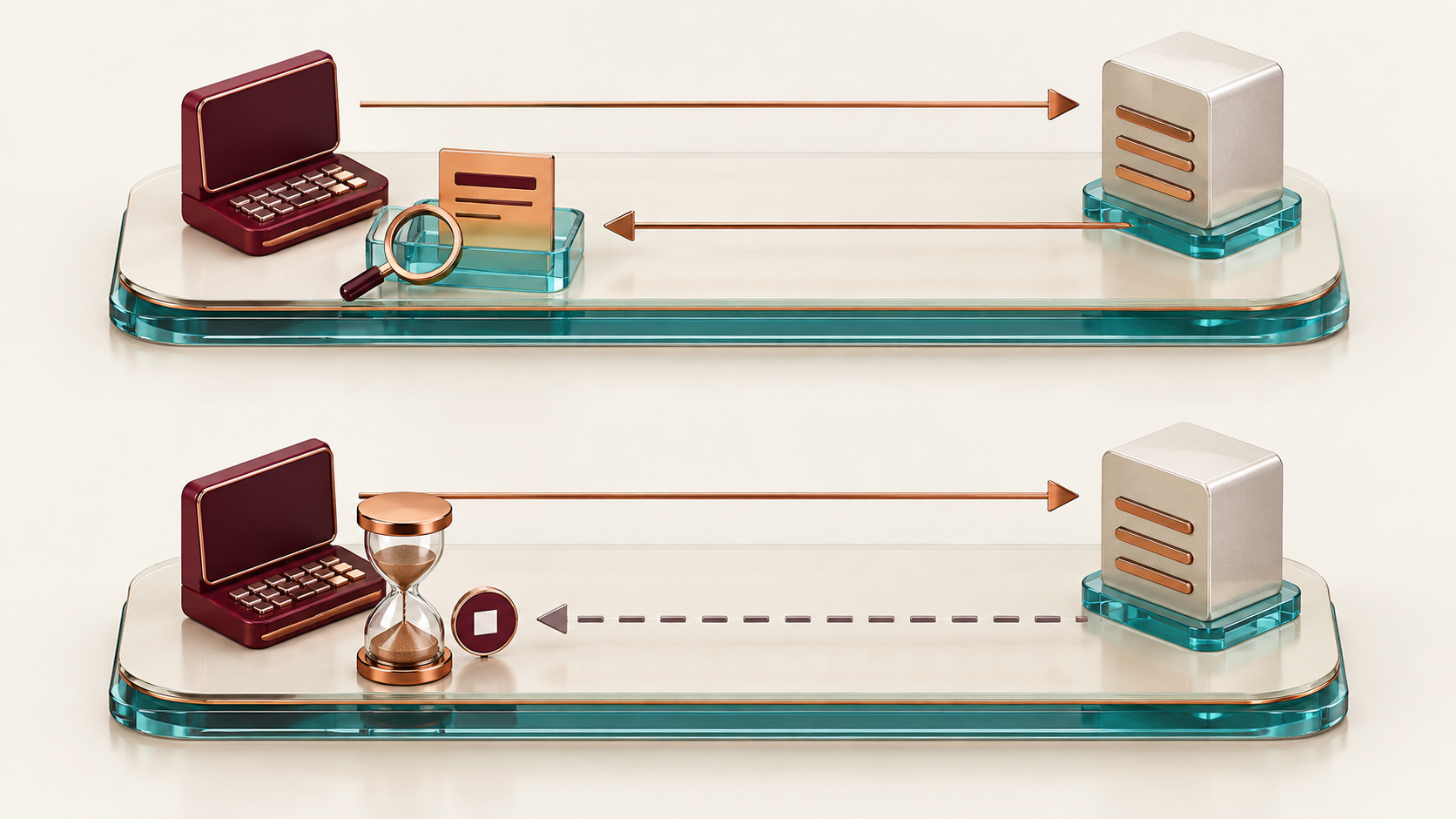
1. Require an actual HTTP response before calling it 408
HTTP 408 describes a server that did not receive a complete request within its waiting time. A client timeout is a local decision to stop waiting; it does not itself establish any HTTP status. Keep separate fields for received status, client exception category and the phase reached. A library may synthesize a status-like number for its own errors, so verify how that library represents a response.
Save the response status and sanitized headers if present, method, operation ID, attempt number, protocol and phase timings. For an HTTP/1.1 response the status line is useful evidence; HTTP/2 and HTTP/3 expose status differently. Do not require an HTTP/1 text line from every protocol. A timeout word in an HTML page or an exception string alone is insufficient.
2. Locate CONNECT and the inner target response separately
- Identify whether the configured proxy uses HTTP forwarding, HTTP CONNECT or SOCKS5. Do not invent a CONNECT phase for SOCKS5.
- For HTTPS through an HTTP proxy, record whether CONNECT succeeded before target TLS began.
- If 408 was returned while establishing CONNECT, classify it at the proxy-facing HTTP exchange; the encrypted target request has not thereby been proven to run.
- If CONNECT and target TLS succeeded and the inner request received 408, correlate target-facing ingress records. Do not automatically attribute it to the residential exit.
- If no response was received, record the last completed phase and local deadline instead of converting the event into 408.
An ordinary non-intercepting tunnel cannot read the encrypted inner request. Response branding, a Server header or missing sampled application logs cannot conclusively identify the generator. Use owner-accessible ingress request IDs, timestamps and receiver records; mark any unobserved layer unknown. A 504 response is another received status with a different gateway context, not a replacement name for a local timeout.
3. Build three small read-only controls
Use an owned staging fixture and synthetic data. Run the same short request on an approved baseline and selected proxy route with fixed method, headers, region, session policy and client configuration. Limit attempts and give every attempt its own correlation ID.
- Normal control: the fixture returns the agreed product marker promptly. Verify the response body and marker as well as status.
- Local-deadline control: the fixture receives a complete request but deliberately delays its response beyond the client's short test deadline. The client should classify a local timeout without inventing a received 408. Check the receiver later; the operation may have reached it.
- Explicit-response control: the owned fixture deliberately returns HTTP 408 to a complete test request. This checks status propagation and classification only. It does not prove that a real server request-read timeout occurred.
If the owner also needs to validate a genuine request-read timer, do it separately in an isolated harness under a documented server configuration and resource cap. Do not deliberately hold incomplete requests open against public sites. Keep a synthetic status-injection test clearly labeled rather than claiming it reproduced a production timing failure.
4. Compare delivery evidence before increasing timeouts
For a real incident, correlate when the client started, when connection and TLS completed, when request headers and body finished if observable, when the receiver recorded completion and when a response arrived or the local deadline fired. Keep elapsed durations on a monotonic clock and note uncertainty across machines. Client bytes handed to an operating system are not proof that the server received the whole message.
A request producer stalled before completing its body needs different work from a complete request followed by slow application processing. A local total deadline can expire before either side's own timer. Raising every timeout together removes the ability to distinguish these cases and can occupy more connections. Use the existing proxy timeout budget guide when changing a specific measured phase budget.
5. Recover only after checking operation and connection state
For the read-only fixture, allow at most the approved bounded repeat after classification and connection-state checks. If an HTTP/1.1 connection is closed or no longer usable after 408, use a new usable connection rather than returning the broken one to the pool. Do not add Connection: close indiscriminately to HTTP/2 or HTTP/3; follow the client's protocol-aware handling.
A new connection does not necessarily mean a new residential exit, and selecting a new session can change the test variable. Record both separately. If failures appear after idle reuse, continue with the existing idle timeout and keep-alive test rather than inferring a provider-wide outage.
For a write or a transport interruption with unknown outcome, reconcile the operation before another submission. An outer timeout label is not a receipt from the application. The POST timeout and duplicate-submission guide covers that separate decision. Stop on explicit access refusal and never rotate identities to bypass server controls.
6. Use 98IP for a controlled regional comparison
The 98IP dynamic residential IP page is relevant when a permitted task must be compared from selected customer regions. Obtain supported connection settings from the configuration documentation and your account. Verify actual egress and keep the region and session policy steady while comparing response classification.
A regional route helps investigate where behavior differs; it does not guarantee an endpoint completes within a chosen deadline. No throughput, timing precision, client compatibility or failed-request billing claim is made here. Use small fixtures, inspect actual usage and collect only authorized data. Send support a sanitized evidence packet rather than proxy passwords, tokens or complete customer requests.
7. Acceptance checklist and FAQ
- Received HTTP status, local exception and last completed phase are independent fields.
- CONNECT failures and inner target responses have separate evidence; unknown layers remain unknown.
- The normal control returns the right marker, the local-deadline case invents no status, and injected 408 is labeled synthetic.
- Connection disposal and bounded recovery do not silently change exit or session variables.
- Unknown write outcomes are reconciled; secrets and customer payloads are absent from shared logs.
Does a long wait prove 408? No. The status must be received as part of an HTTP response. A timer expiring without that response is a local timeout observation.
Can an unused connection receive 408? Some servers send it while closing an idle connection, including a preconnected one. Correlate the connection and outstanding request before assigning it to a particular operation; other servers may simply close.
Should I always change IP after 408? No. First establish response phase, request completion and connection usability. Changing exits can obscure a reproducible client or target issue and add unbounded attempts.
Related Recommendations
- Correct Currency, Wrong Decimals? Test Display Rounding Through Regional Proxies
- WebSocket Proxy Compatibility Test: Handshake, Heartbeat and Recovery
- Proxy Bandwidth Cost Estimation: Budget by Useful Results, Not Price per GB
- Market Selector Opens but Keyboard Users Get Stuck? Test Focus Through Regional Proxies
- Can Visitors Reach Every Language URL? A Regional Proxy Audit Before Launch
- How to Troubleshoot Proxy Authentication and 407 Errors with curl
- http global proxy: how to set up a stable connection
- Proxy Credential Encoding Validation: Prevent 407 Errors and Secret Leaks
- Proxy Idle Timeout and Keep-Alive Test: Prevent Stale Connection Failures
- Browser Says Online but the Proxy Request Fails? Test the Hint and Target Separately