
How to Test Request Cancellation Through a Proxy Without Leaving Orphan Traffic
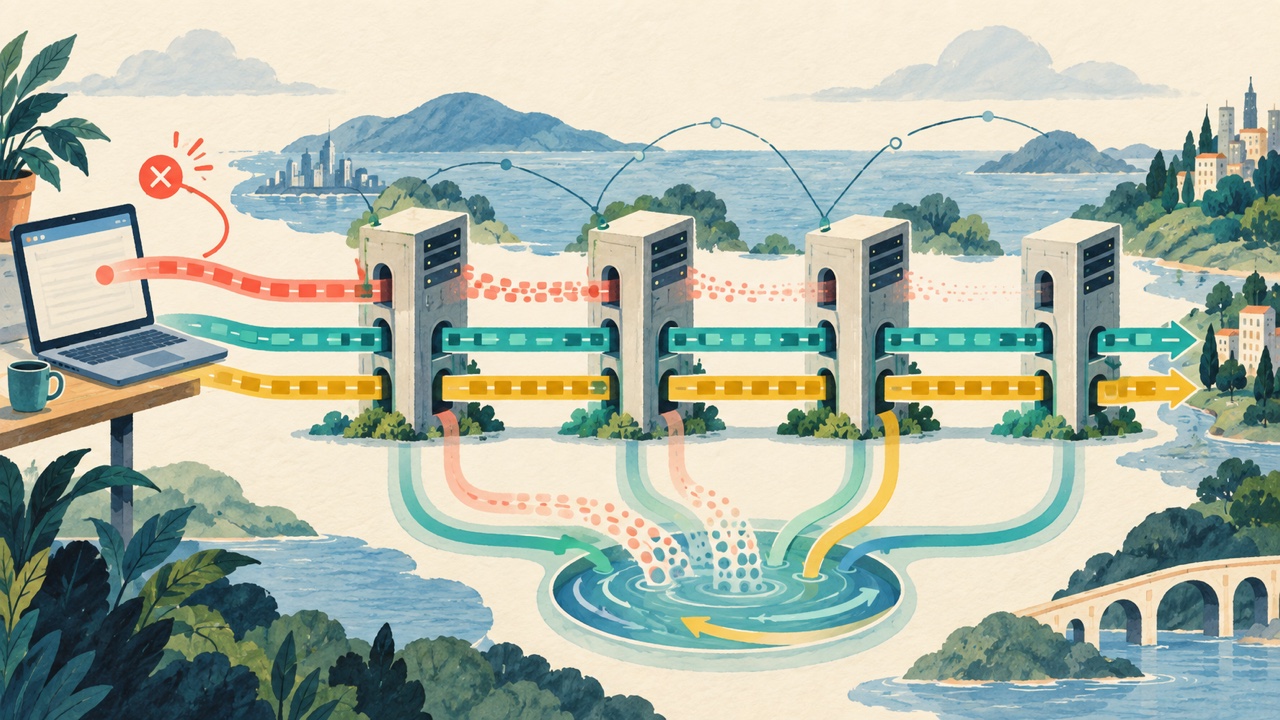
Stopping a browser tab, aborting an API request or cancelling a scraping job does not automatically prove that work stopped everywhere. The client may abandon its response while the proxy continues forwarding bytes, the destination continues generating a large body, a retry queue creates a replacement request, or a pooled connection remains occupied until a timeout.
Those hidden effects waste proxy bandwidth, consume concurrency, distort billing and can duplicate data collection. This guide builds a controlled cancellation test for authorized HTTP, HTTPS CONNECT, SOCKS and browser-based proxy workflows.
Define what “cancelled” must mean
A useful cancellation contract covers every layer:
| Layer | Expected result |
|---|---|
| application | the task ends with an explicit cancelled state, not success |
| retry controller | no replacement attempt is created unless policy deliberately allows it |
| client transport | the response body stops and the stream or socket is released |
| proxy route | the tunnel or request stops consuming active capacity |
| controlled destination | generation or transmission stops, or its completion is classified separately |
| accounting | transferred bytes and request counts remain explainable |
Do not define success as “the caller returned quickly.” The user-visible operation can finish while background traffic continues.
Build a safe test fixture
Use a destination you control. It should provide four deterministic endpoints:
- a slow response that emits numbered chunks at fixed intervals;
- a delayed first-byte response;
- a bounded upload receiver that reads slowly;
- a normal small response used as a post-cancellation health check.
Give every request a synthetic test identifier. The destination should record only the identifier, timestamps, received or sent byte counts, connection state and completion reason. Do not place proxy credentials, cookies, personal data or real customer URLs in the fixture.
Run the same test directly and through each authorized route class. Direct access is a diagnostic control, not a production fallback.
Choose cancellation points
Cancellation behavior changes with timing. Test at least these points:
- before DNS or proxy connection setup completes;
- during proxy authentication or CONNECT negotiation;
- after response headers but before body bytes;
- midway through a streamed download;
- midway through a bounded upload;
- while waiting in the client concurrency queue;
- immediately after a retryable-looking error;
- during application shutdown.
Change one condition per run. Otherwise a timeout, server close and user cancellation can be confused in the same trace.
Capture evidence at both ends
At the client, record:
test_id
route_class
cancel_requested_monotonic_ms
client_returned_monotonic_ms
bytes_sent_before_cancel
bytes_received_before_cancel
retry_count_after_cancel
active_connections_before_after
queued_requests_before_after
final_reason_code
At the controlled destination, record the first request byte, first response byte, last observed byte, disconnect or completion time, and total bytes. Compare events by test identifier. Use a monotonic clock for durations and synchronized UTC only for cross-system correlation.
Avoid packet captures unless they are necessary, authorized and protected. Most acceptance tests can rely on application, proxy and fixture counters without collecting unrelated payloads.
Test download cancellation
Start the slow chunked response through the proxy. After a fixed number of chunks, cancel from the application using the runtime's supported cancellation mechanism. Do not terminate the whole process unless process death is the scenario under test.
Verify that:
- the client reports cancellation rather than a successful partial body;
- no parser commits the incomplete response to a dataset;
- the controlled destination observes the stream ending within the agreed cleanup window;
- proxy active-request or connection usage returns to baseline;
- no automatic retry starts with a new exit IP;
- a small follow-up request succeeds on a known-good route.
The proxy response integrity test provides additional checks for preventing partial bodies from being accepted as valid results.
Test upload cancellation
Uploads reveal a different risk: the destination may already have accepted some or all of a request before the client learns the final outcome. Use a synthetic, disposable object and a destination that exposes how many bytes it received.
Cancel at several percentages. The client must report an ambiguous or cancelled result, never assume the operation was rolled back. For any operation with side effects, use an idempotency key or a destination-supported status lookup before retrying.
Never repeat a cancelled purchase, form submission or account mutation merely because the proxy connection closed. Transport uncertainty is not proof of business failure.
Verify retry suppression
Many retry libraries classify cancellation as a timeout, reset or generic network error. That can create a replacement request immediately after the user asked the job to stop.
Add a cancellation reason that travels with the task. The retry layer should evaluate it before status codes or exception classes. Assert that retry count remains zero after an explicit user or scheduler cancellation. If a shutdown policy permits a narrowly defined resume later, create a new task with a new decision record rather than silently continuing the old one.
The proxy 429 and retry-handling guide can be used to separate permitted transient recovery from cancellation, rate limits and permanent failures.
Check connection-pool behavior
Cancellation does not always require closing an entire connection. HTTP/2 and HTTP/3 can cancel one stream while healthy streams continue. HTTP/1.1 clients may need to close or discard a connection when the body cannot be safely drained. Test the exact runtime and protocol used in production.
After each cancellation, measure:
- active and idle connection counts;
- time until the concurrency slot is reusable;
- whether the connection returns to the pool;
- whether a follow-up response is framed correctly;
- whether another in-flight stream was affected;
- file descriptor and memory movement across repeated cycles.
A connection that is unsafe for reuse must be retired. Reusing a socket with unread response bytes can attach old bytes to a new request and corrupt the next result.
Define acceptance thresholds
Set thresholds before running the test. A sample contract might require:
- application cancellation acknowledgment within 250 milliseconds;
- no new retry after the cancellation timestamp;
- destination disconnect observed within 2 seconds for streamed fixtures;
- active concurrency returned to baseline within 3 seconds;
- zero partial records committed;
- zero credential or payload leakage in logs;
- follow-up control request successful;
- provider byte counters reconcilable within the documented measurement delay.
Choose values that reflect your runtime, region and proxy product. The goal is an explicit, repeatable contract—not universally tiny numbers.
Troubleshooting matrix
| Observation | Likely investigation |
|---|---|
| client returns but destination keeps sending | transport abort propagation and body-drain behavior |
| cancellation creates a fresh request | retry classification and task-state propagation |
| concurrency remains occupied | pool release, tunnel close and gateway accounting |
| next response contains unexpected bytes | unsafe HTTP/1.1 connection reuse |
| upload may have completed | idempotency and destination status reconciliation |
| only one market fails cleanup | regional gateway, protocol or network intermediary |
| direct route cleans up but proxy route does not | proxy tunnel behavior, not application cancellation alone |
Production checklist
- Every task has a stable synthetic request identifier.
- Cancellation is distinct from timeout, failure and success.
- Retry logic checks cancellation first.
- Partial downloads never enter the dataset as complete.
- Side-effecting uploads use idempotency or status reconciliation.
- Connection-pool counters return to baseline.
- Unsafe connections are removed from reuse.
- Direct fallback remains disabled where a proxy is required.
- Logs exclude credentials, cookies and raw payloads.
- Provider accounting is compared with client and fixture evidence.
- IPv4, IPv6, HTTP proxy and SOCKS modes are tested as applicable.
- Results are reviewed separately for Global, North America, Europe and APAC routes.
FAQ
Should cancellation close the whole proxy connection?
Not always. Multiplexed protocols can cancel one stream without harming others. The acceptance requirement is that cancelled work stops and resources are released without corrupting neighboring requests.
Is a timeout the same as cancellation?
No. A timeout is a policy decision after waiting too long. Cancellation is an explicit stop signal from a user, scheduler or shutdown process. They may produce similar transport errors but require different retry behavior.
Can rotating to a new proxy solve a stuck cancellation?
No. Rotation can create duplicate work and hide a cleanup defect. Fix cancellation propagation and resource accounting first.
How should cancelled traffic be billed?
Use the provider's documented measurement definition. Bytes already transferred may remain billable. Reconcile client, proxy and controlled-destination counters instead of assuming cancellation erases usage.
Compliance note
Run cancellation tests only against destinations and proxy accounts you own or are authorized to test. Use synthetic content, conservative traffic, explicit cleanup windows and minimal logs. Do not cancel and rotate requests to evade rate limits, access controls or publisher decisions.
Related Recommendations
- How to Build Verifiable Proxy Egress Evidence
- POST Timeout Through a Proxy: Prevent Duplicate Submissions
- How to Detect Residential Proxy Session Collisions Before Production
- Browser High-Speed Proxy IP: Detailed Selection and Usage Guide
- How to Test Cross-Market Proxy Failover Without Corrupting Geo Data
- Is the Proxy Failing—or Is the Target Throttling You? A Control-Route Test Plan
- SOCKS5 Remote DNS Resolution Test: Verify the Full Proxy Path
- How to Test Proxy Keep-Alive Without Breaking IP Rotation
- Proxy Gateway Certificate Expiry Runbook: Monitor, Rotate, and Verify Without Downtime
- Browser Proxy Bandwidth Budgeting: Measure Cost Before You Scale