
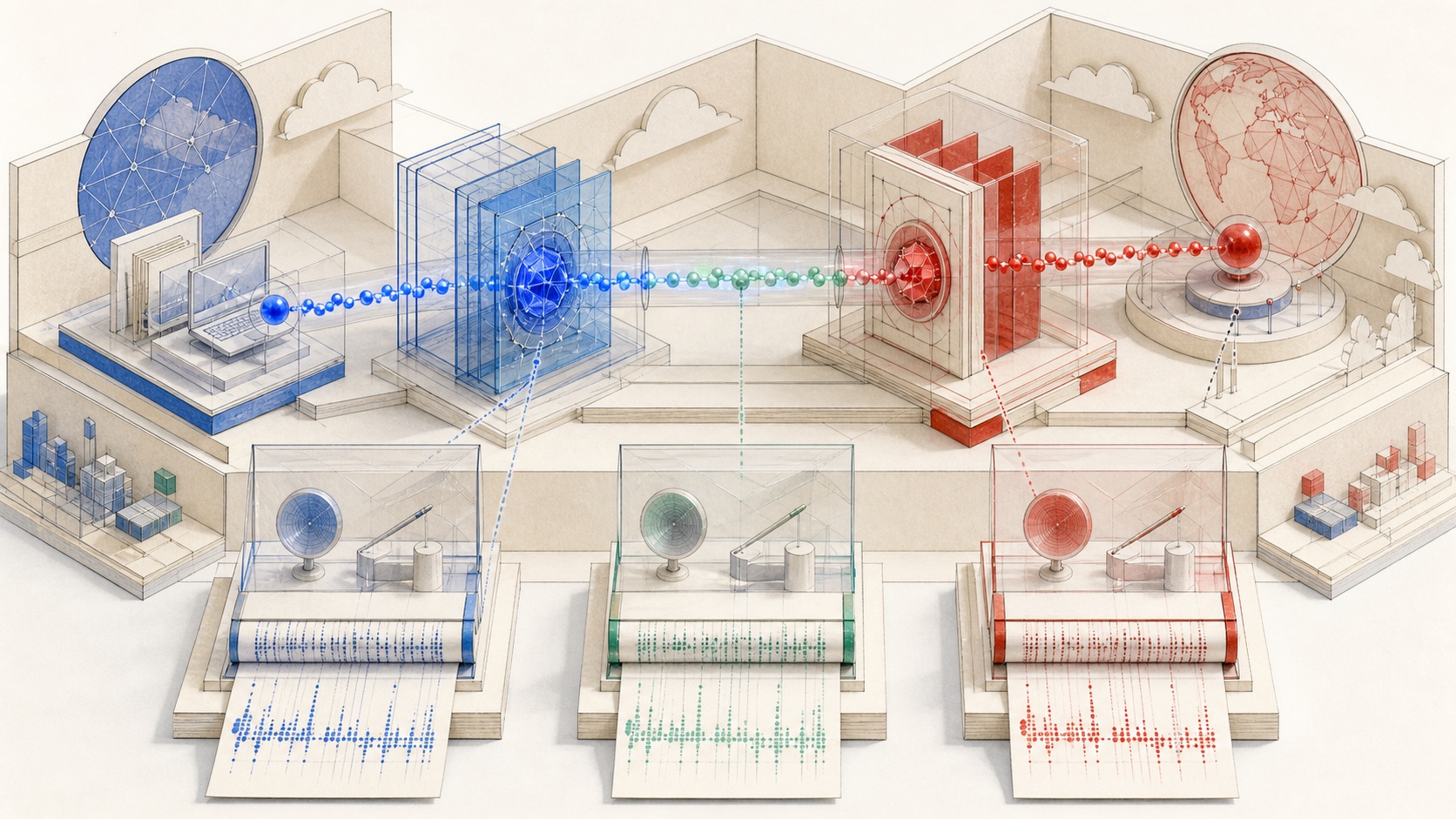
A visible exit IP is useful, but it is not an audit trail. It does not prove which account, gateway, retry, address family, or connection produced a request. It also cannot show whether another attempt bypassed the proxy before the successful response. Teams evaluating residential, rotating, datacenter, IPv4, or IPv6 proxies need evidence that can be joined across the route.
This guide describes a lightweight egress attestation process. It is not a cryptographic product claim. It is a repeatable method for collecting independent observations and deciding whether a request followed the approved path.
Define the claim before collecting evidence
Write one testable sentence for each workload. For example: “Every request from this collector must use an approved proxy pool in the selected region, resolve the destination through the intended DNS mode, and either succeed through that pool or fail closed.”
Break the claim into attributes:
- workload and test profile;
- proxy account or pool identifier;
- expected country or region;
- protocol and DNS mode;
- IPv4 or IPv6 requirement;
- allowed retry and rotation behavior;
- maximum session duration;
- destinations covered by the test;
- evidence retention period.
Without this definition, a changing residential IP can be mistaken for failure even when rotation was expected, or a stable address can be mistaken for success even when the request bypassed the authorized pool.
Use four independent observation points
1. Client observation
Record a generated request ID, start and finish time, selected proxy profile, attempt number, library error, and timing. Do not include passwords, cookies, authorization headers, or full query strings. Start a fresh process for at least one test so connection reuse cannot hide the selected route.
2. Proxy gateway observation
Record the same safe request ID where possible, account or pool label, ingress time, target host and port, selected exit, address family, bytes, result, and gateway error. The client and gateway clocks should use a consistent time source.
3. Destination observation
Use a destination you control or are authorized to test. Record the source address seen by the destination, arrival time, request ID, protocol, and a response nonce. The destination should not echo sensitive request headers.
4. Network and DNS observation
Confirm whether the workload opened any direct connection and whether DNS resolution occurred locally or through the intended proxy mode. This is especially important for SOCKS configurations, dual-stack clients, bypass lists, and connection pools.
Do not treat forwarding headers as proof
Forwarded and X-Forwarded-For headers can be useful diagnostics, but they are not independent evidence of the transport path. A client or intermediary can add, omit, or modify them. Treat them as contextual data only, and trust values only from explicitly controlled intermediaries. Never publish an internal proxy chain merely to prove that a request was proxied.
The stronger signal is agreement between gateway telemetry and the source address observed at the authorized destination, joined by a request ID and bounded time window.
Build the minimum evidence record
For each attempt, keep:
- test run ID and request ID;
- UTC start and end timestamps;
- client profile and software version;
- proxy pool label, not the credential;
- intended protocol, DNS mode, region, and address family;
- gateway connection result and selected exit;
- destination-observed source address;
- status code or categorized error;
- retry reason and parent request ID;
- a hash of the normalized evidence bundle.
Normalize timestamps and field names before hashing. Store the evidence bundle separately from business payloads so access and retention can be controlled independently.
Run a compact test matrix
Healthy route
Send several harmless requests through the intended pool. Confirm a one-to-one match between client attempts, gateway events, and destination events. Repeat across every purchased region and supported address family.
Rotation and stickiness
For rotating pools, confirm that changes occur only within the allowed scope. For sticky sessions, verify that the same session token retains the expected exit until the documented boundary, then rotates cleanly.
Authentication and gateway failure
Use isolated invalid test credentials and an unreachable test gateway. The destination must receive no request. A successful destination event without a gateway match is a fail-open signal.
Retry behavior
Trigger a controlled timeout and inspect every attempt. Retries may use another authorized exit, but they must remain linked to the original request and must not switch to direct egress.
DNS and dual-stack behavior
Test local versus remote DNS intentionally. Repeat with IPv4-only, IPv6-only, and dual-stack profiles. Confirm that the destination family and gateway selection match the declared policy.
Apply explicit pass and fail rules
A request passes when the client attempt, proxy event, and destination observation agree on request ID, time window, destination, route policy, and outcome, with no direct network event. A request fails when any required observation is missing, duplicated without explanation, outside the time window, or inconsistent with the expected pool, region, DNS mode, or address family.
“Unknown” should be a separate result. Missing telemetry is not proof of success. Keep ambiguous tests out of production acceptance metrics until they are repeated with complete observation.
Protect the evidence
Use least-privilege access, append-only storage where practical, synchronized clocks, defined retention, and alerts for deletion or clock drift. Redact credentials and personal data before storage. Sanitize line breaks and control characters in user-influenced fields to reduce log-injection risk. Do not retain full response bodies unless the test explicitly requires them.
Provider evaluation checklist
- Can events be joined with a customer-supplied safe request ID?
- Are selected exit, region, protocol, and address family visible?
- Are authentication, DNS, tunnel, timeout, and destination errors distinct?
- Are timestamps precise and clocks synchronized?
- Can logs be exported without credentials or sensitive headers?
- Is retention documented and configurable?
- Can you distinguish pool rotation from direct fallback?
- Is IPv6 evidence available separately from IPv4?
FAQ
Is a screenshot of an IP-check page sufficient?
No. It proves only one displayed response and is difficult to join to a specific gateway event, retry, or DNS path.
Should the proxy expose the original client IP in a header?
Not as a default proof mechanism. Forwarding headers can reveal private topology and can be altered. Use controlled telemetry and destination observations instead.
How many tests are enough?
Cover every required region, protocol, address family, failure mode, and session behavior. Repeat enough times to observe rotation boundaries and transient errors; do not replace coverage with an arbitrary request count.
Compliance note
Use only systems, destinations, accounts, and data you are authorized to test. Evidence collection does not grant permission to access a website or process personal data. Follow applicable terms, privacy rules, retention requirements, and regional law.
Review the internal proxy guides and 98IP resources before approving a new egress profile.
Related Recommendations
- How to Test Proxy IP Reputation Before Production
- Browser Proxy Bandwidth Budgeting: Measure Cost Before You Scale
- Replay Proxy Requests Safely with Chrome DevTools 152
- How to Audit HTTP/2 Proxy Connection Reuse Without Mixing Tenants
- Proxy Pool Quarantine and Recovery: Stop Unhealthy Exits From Returning Too Soon
- How to Evaluate a Proxy Trial Before Buying: A 60-Minute Acceptance Test
- Shared vs Dedicated Proxies: A Procurement Acceptance Test
- How to Capacity-Plan Proxies for 200 Parallel Browser Sessions
- How to Forecast Residential Proxy Bandwidth Before Buying a Plan
- How to Sanitize HAR Files Before Sharing Proxy Debug Logs