
Long product-filter links can fail with 414 after extra conditions are added. Before rotating residential exits, measure the serialized request target and locate the component that refused it. This guide is for authorized website testing and market-research integration. It proposes a test procedure, not a measured limit of 98IP or a target service.
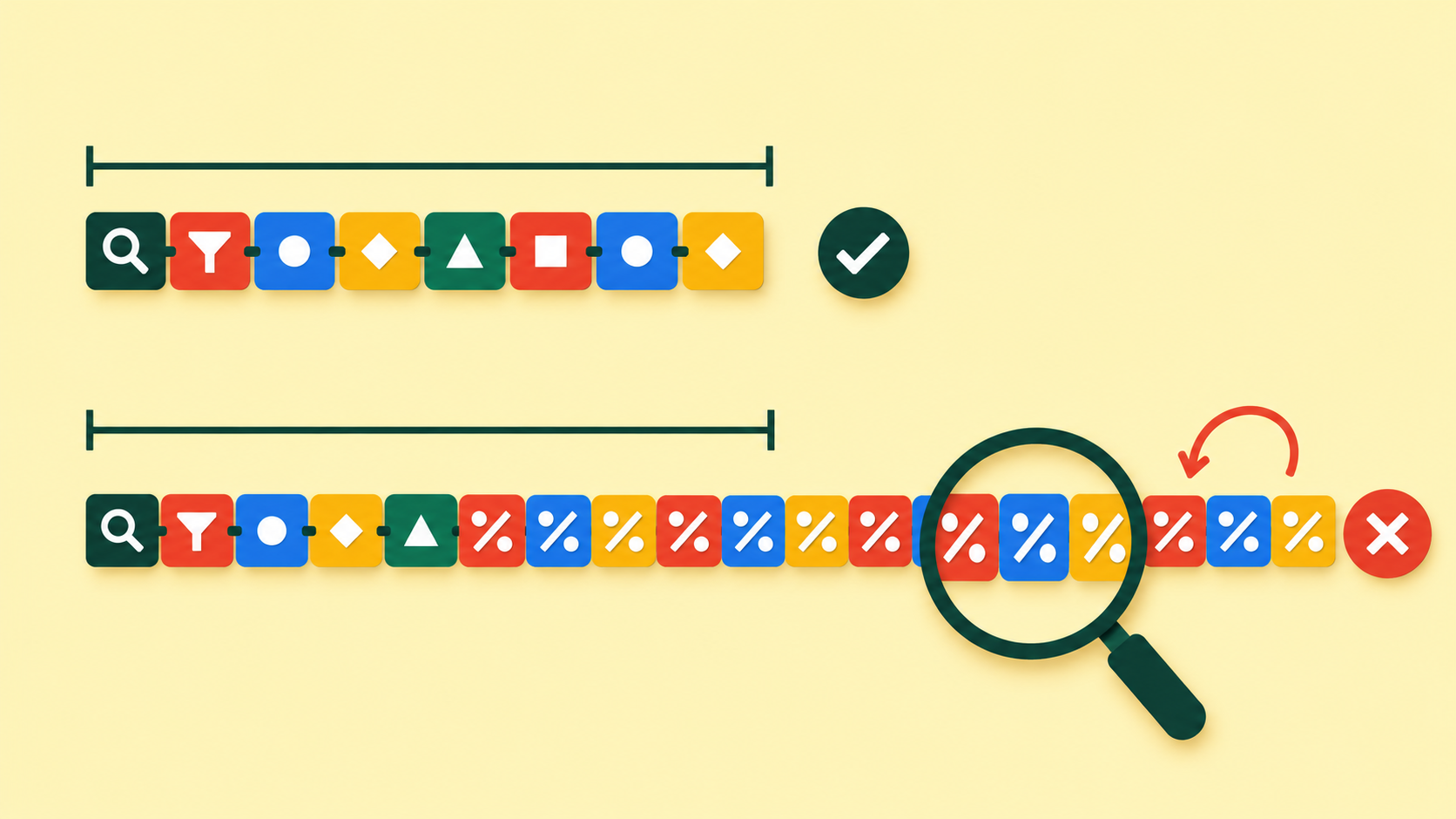
1. Separate URI length from headers and body
HTTP 414 means the target URI exceeds what the responding server is willing to interpret. A large body and large headers are different diagnoses. Obtain the actual status and corresponding request; a timeout or browser error page alone does not establish 414. Record method, destination, path, encoded query length, redirect count and a sanitized response identifier.
Measure the serialized representation at the boundary being investigated. A visible character count is not a wire-length measurement: non-ASCII values can occupy several UTF-8 bytes, and each percent-encoded byte occupies three ASCII characters. Record path plus query separately from the complete absolute URI. HTTP forward-proxy and origin requests may use different target forms; HTTP/2 does not have an HTTP/1 request line. One length value cannot prove every intermediary's limit.
2. Build a small controlled comparison
- Choose an owned read-only search endpoint and synthetic filter values. Independently define the required filter set and expected result identity before constructing URLs.
- Freeze client version, serializer settings, method, headers, cookies, region and proxy session policy. Change only the number or size of filters.
- Prepare a valid short control and two larger cases within the owner's approved budget. Two, four and eight short synthetic values are example inputs, not proposed production thresholds.
- Run the same cases through an approved baseline and the proxy path. If direct access is prohibited, compare approved paths and mark that missing control.
- Record serialized path/query byte counts, actual status, redirect hop, receiver correlation ID and whether all expected filters arrived. Stop once a repeatable boundary is established.
Do not send huge URLs or run an unbounded binary search against public services. For a documented limit in your own staging stack, use a small approved fixture just below, at and above it; equality behavior must be observed. A 200 response that silently drops the final filters fails acceptance.
3. Find the first rejecting boundary
Compare the outgoing target with owner-accessible ingress, CDN, reverse-proxy and application receiver records. A response template or Server header provides a clue, not proof of its generator. Correlate request IDs and timestamps. Absence from a sampled application log does not prove the forward proxy rejected the request.
In an ordinary CONNECT tunnel, a non-intercepting forward proxy cannot read the encrypted HTTPS path and query. Query-related failures need evidence from target-facing layers or an explicitly configured interception layer. Separate CONNECT establishment failure from a 414 received after target TLS and the inner request. Changing residential exits cannot increase a target server's URI limit.
4. Check redirect growth before deleting parameters
In a staging diagnostic client, disable automatic following and inspect each approved Location before sending the next hop. Keep a small explicit hop cap and record sanitized lengths. Look for nested return URLs, repeated locale prefixes, duplicated filters or percent signs encoded again on each hop. Never forward credentials to an unexpected external destination.
A loop can make an initially short address grow until a component refuses it. Fix the URL builder or redirect rule and rerun from the original entry point. Trimming the final failed hop can conceal the loop and change the intended search. If the initial request is already oversized, investigate serialization and the API contract instead.
5. Preserve the search contract when repairing
- Remove duplicates or obsolete parameters only when the owner confirms semantic redundancy. Preserve meaningful repeated keys, ordering, signatures and locale settings.
- Correct accidental double encoding at the builder boundary. Do not repeatedly decode an entire URL: encoded separators may be data, and changes can alter parsing or invalidate signatures.
- Use documented POST search or a saved-query identifier only when the service supports it. Recheck content type, authorization, pagination, caching and the same expected result set. Forcing GET into POST does not create API support.
- If you own every ingress, review their documented limits and resource budgets together. Raising one limit cannot repair a lower one elsewhere. Do not change services you do not operate.
Check caching after repair too: HTTP rules permit caching a 414. On an owned route, use supported revalidation or purge procedures and correlate a fresh receiver observation. Adding random query parameters makes the URI longer and may break signed links; it is not a universal cache test.
6. Use 98IP for the regional comparison
The 98IP dynamic residential IP page is relevant when a repaired search needs verification from selected customer regions. Obtain supported connection settings from the 98IP configuration documentation and your account. Keep region and session policy fixed within a length comparison and verify the actual egress for each run.
Regional checks can expose different application redirects or edge configurations. They do not prove unlimited URL length, identical regional policies or successful parsing. This guide promises no measured throughput, compatibility or free failed requests. Limit attempts, check actual usage accounting and test only authorized targets and data.
7. Acceptance checklist and FAQ
- Short and repaired larger requests reach the intended endpoint with every required filter, correct locale and expected result identity.
- The serialized representation and first rejecting boundary are documented; unobserved layers remain explicitly unknown.
- Redirect lengths stop growing, hop caps remain enforced and credentials stay within approved destinations.
- Headers, body size and transport failures have separate evidence; the 414 conclusion comes from a real response.
- Cache handling and retry budgets are recorded, with query secrets, customer identifiers and proxy passwords removed from support evidence.
Should I retry on many IPs? Repeating an unchanged oversized request usually adds consumption without addressing its length. First reproduce a bounded case and repair the builder or confirmed rejecting layer.
Can I split one search into several shorter requests? Only if the API supports an equivalent merge. Intersections, ranking and pagination can change when filters are split; validate against independent expected results before adopting that design.
Is a shorter URL automatically correct? No. Omitting a market filter or returning default results is a functional failure even if the status is 200.
Related Recommendations
- How to Detect Cross-Session Cache Contamination in Proxy Data Collection
- Proxy Bandwidth Cost Estimation: Budget by Useful Results, Not Price per GB
- Regional Proxy Hreflang Validation: Check the Whole Language Cluster
- How to Test Proxy Keep-Alive Without Breaking IP Rotation
- Proxy Exit IP Allowlist Rollover: A Zero-Downtime Migration Runbook
- How to verify the location accuracy of residential agents before expanding traffic
- How to Run a 7-Day Residential Proxy Purchase Pilot
- Proxy Geo-Targeting Accuracy Audit: Test Country, Region, City and ASN Claims
- Proxy NAT64 and DNS64 Compatibility Test for IPv6-Only Networks
- How to change IP in a virtual machine?