
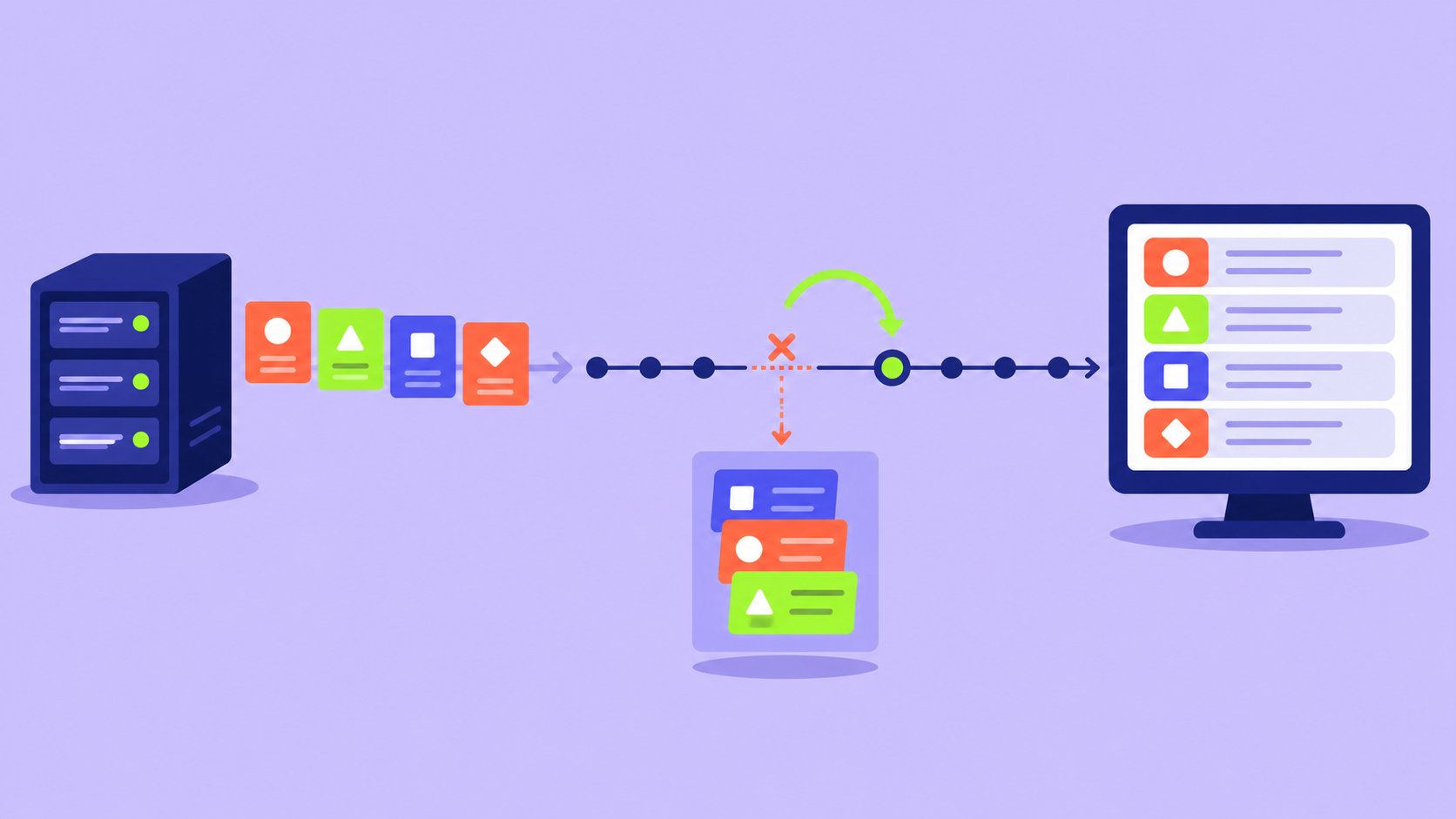
A dashboard opens an event-stream connection but updates arrive in a burst or stop after a reconnect. HTTP200 and an open connection are weak acceptance criteria. For authorized regional website tests, measure the application events actually received and distinguish transport, buffering and origin replay.
Prepare a deterministic fixture
Use an owned staging endpoint emitting a finite set of known event IDs, alternating ordinary messages and one named event. Choose a documented emission interval and a quiet period with harmless heartbeat comments. Confirm text/event-stream, valid UTF-8 and complete message boundaries. Define allowed arrival gaps and missing-event tolerance from your product requirements, not an invented universal proxy threshold.
Record delivery at the browser
- Open a clean test browser through an approved baseline route, then a separate residential-proxy run. Keep account, endpoint, browser and fixture identical.
- Record each delivered ID, event type and arrival time using a monotonic client clock. Compare adjacent arrival gaps; do not infer one-way network latency by subtracting unsynchronized server and client clocks.
- Attach the handler for the named event as well as ordinary messages. A handler mismatch can look like lost data even when transport succeeds.
- Compare the known ID set and order with each run. Record duplicates separately. Heartbeat comments are not business events and may not appear in message handlers.
Locate buffering before changing routes
If a known steady emission becomes a burst, compare origin flush evidence and each controlled route. Buffering can occur in the application, reverse proxy, CDN or client path; the last visible component is not automatically responsible. Inspect the actual deployed configuration and keep security checks intact. An error callback alone cannot identify the buffering layer.
Test reconnection and replay separately
In owned test infrastructure, interrupt the stream after a recorded ID. Observe reconnection and inspect the continuation state supported by the client and origin. An event ID helps identify position but does not create a server replay store. Verify whether retained events are replayed, duplicated or unavailable; document retention and resynchronization behavior. A newly created client may need application-managed recovery rather than assuming it inherits the old instance's state.
Test an interruption within retention and one after retention. When history is unavailable, use the approved snapshot/resynchronization flow and visibly mark the gap. Do not silently present partial history as complete. Close the event client when the page or test ends, then confirm no orphan connection remains.
Choose a 98IP route and define the limit
Use 98IP dynamic residential proxies for authorized regional residential viewpoints, with account settings checked through the operation guides. Measure the full intended stream duration before relying on a session setting; this article promises no specific lifetime or SSE compatibility result.
Keep one route per case and use a finite reconnect budget. Pause on access denial or rate limits rather than rotating IPs to evade them. Browser connection limits and negotiated protocol behavior also affect multiple-tab tests; reproduce the actual deployment instead of assuming unlimited streams.
Acceptance checklist and FAQ
- Known ordinary and named events arrive within the product's gap budget; counts, IDs and duplicates are documented.
- Quiet periods and reconnects behave as specified; expired history triggers visible resynchronization.
- Closed pages leave no orphan stream, and sanitized evidence excludes tokens, cookies and personal event payloads.
Does reconnection guarantee no missing events? No. The origin must implement an appropriate replay or resynchronization contract.
Does a heartbeat prove the dashboard is current? No. Verify business-event delivery and applied state independently.
This fixture is a test design, not a measured 98IP benchmark. Use owned or authorized endpoints, respect terms and request limits, and avoid real customer notifications or sensitive data.
Related Recommendations
- Regional Proxy Time Zone Testing: Prevent Wrong Dates and Deadlines
- How to Switch Proxy Providers Without Breaking Production
- How to set up a computer to access the Internet with dynamic IP? What is the use of dynamic proxy IP?
- How to Verify Proxy Location Accuracy: Country, City, ASN and DNS Checks
- NO_PROXY Configuration Guide: Domains, Ports, CIDR, and Safe Bypass Rules
- Proxy Geolocation Consensus Test: Validate Country, Region and Usability
- How to Test a Proxy for DNS Leaks Before You Buy
- How to set a computer to access the Internet with static IP? Here are the detailed steps
- How to Test SOCKS5 UDP ASSOCIATE Before Buying a Proxy Plan
- How to Test TLS Certificate Revocation Through a Proxy